Arctic grayling Native
🔬 Thymallus arcticus
A freshwater fish in the salmon family (Salmonidae). Distinguished by its large, sail-like dorsal fin with iridescent spots. The genus name derives from thyme, as a faint smell of the herb thyme emanates from the flesh. Features a dark midlateral band between pectoral and pelvic fins, with flanks displaying possible pink iridescence. Lifespan of up to 18 years recorded.
🎣 Get Full Stocking Data & Forecasts
Fishing Pro · $4.99/mo · Cancel anytime
Best season
Summer, early fall
Where to Catch Arctic grayling in Michigan
Arctic grayling Conservation Status
Native Arctic grayling is native to Michigan waters. Extirpated from Michigan by 1936 due to habitat destruction, unregulated logging, and competition from non-native fish. In 2025, reintroduction began with 400,000 eggs planted in coldwater streams. Data sourced from Wikipedia (Thymallus arcticus). CSV flag cleared after manual review.
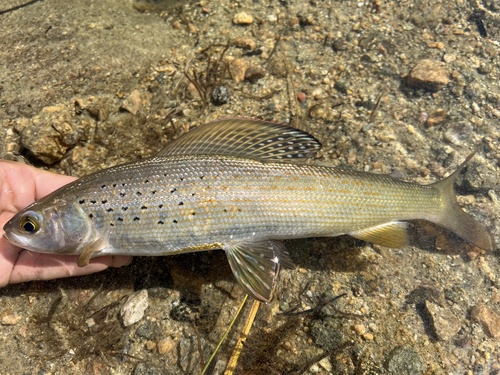
Arctic grayling Habitat & Behavior
Inhabits cold waters of mid-sized to large rivers and lakes, returning to rocky streams to breed. Three life history forms exist: fluvial (river-dwelling), lacustrine (lake-dwelling), and potamodromous (lake-dwelling, stream-spawning). Omnivorous diet includes crustaceans, insects and insect larvae, and fish eggs. Larger specimens become piscivorous; juveniles feed on zooplankton and insect larvae. DNR records show Arctic grayling present in 27 Michigan water bodies. Highest stocking activity on record is in Oakland, Luce and Wexford counties.
Best Arctic grayling Techniques
Dry fly fishing, nymphing, small spinners and spoons
Best Arctic grayling Baits
Dry flies, nymphs, small spinners, insect larvae
Michigan DNR Arctic grayling Stocking Records
Arctic grayling Stocking Events by Lake
| Date | Lake | County | Quantity | Size |
|---|---|---|---|---|
|
13 more recent stocking events available with Fishing Pro
See what's been stocked recently, including lake, quantity, and size.
|
||||
| May 5, 1992 | Sid Lake | Luce | 1,000 | 5.2" |
| May 5, 1992 | Sand Lake | Schoolcraft | 1,000 | 5.2" |
| May 5, 1992 | Madison Spring | 500 | 5.2" | |
| Sep 24, 1991 | Sid Lake | Luce | 2,200 | 3.0" |
| Sep 24, 1991 | Deer Lake | Oakland | 2,400 | 3.0" |
| Sep 24, 1991 | Mulligan Creek | 10,000 | 3.0" | |
| Sep 10, 1991 | Huron River | Baraga | 25,230 | 3.2" |
| Jun 13, 1991 | Fish Lake | Lapeer | 62,160 | 0.6" |
| Sep 19, 1990 | Deer Lake | Oakland | 900 | 4.0" |
| Sep 19, 1990 | Sid Lake | Luce | 646 | 4.0" |
| Sep 18, 1990 | Ackerman Lake | Alger | 1,400 | 4.0" |
| May 11, 1988 | Sid Lake | Luce | 1,000 | 5.8" |
Most valuable for Arctic grayling anglers
See where Arctic grayling will be stocked next
Full stocking history across all 27 lakes, plus a forecast of which waters are due for restocking this season.
Fishing Pro — $4.99/mo
57
Historical stocking events
27
Lakes stocked
Apr
Next likely stocking window
Peak Stocking Months
Apr
May
Sep
Top Stocked Lakes
See the top 5 lakes most likely to be stocked with Arctic grayling next season.
Unlock with Fishing Pro
Forecast based on historical DNR stocking patterns. Not a guarantee of future stocking. Verify with the Michigan DNR.
Angler Tips for Arctic grayling
No tips yet for this species. Fishing Pro members can share tips and photos.
Be the first to share an angler tip
Fishing Pro members only